
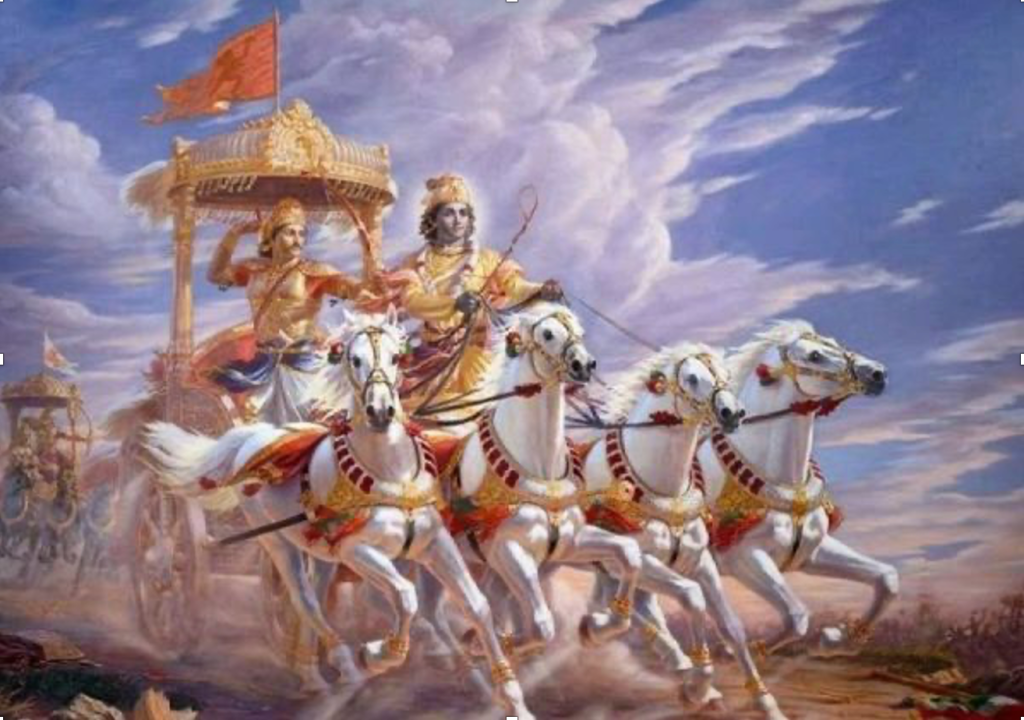
सेनयोरुभयोर्मध्ये रथं स्थापय मेऽच्युत
O Achyuta ! Place my chariot at the middle of both the armies.
You may wonder – what has Arjuna, or for that matter the Bhagavad Gita to do with yoga?
Let us not forget that the first chpter of the Bhagavad Gita is named as Arjuna Vishada Yoga, the second chapter as Jnana Yoga and so on. Each chapter name has yoga in it. ‘Arjuna Vishada Yoga’ literally means the yoga of Arjuna falling into despondence.
Can yoga happens when one falls deep into despondence?
In a way, yes.
Of course we will get a clearer sense of the meaning of yoga as we progress through subsequent blog posts. However, for our immediate purpose the literal meaning of yoga will suffice. Yoga means to connect. This connection is in a spiritual sense. It is connecting with our inner world.
Usually we are immersed in the outer world. A sudden physical pain brings our attention to our body. Mental agony brings our attention to our mind. We become aware that something is happening to us. Or else our mind is too busy chasing external objects to bother about what is happening in the body or mind.
Before the start of the war Arjuna was full of enthusiasm. After all, he was going to take revenge for all the wrongs done to him and his family. On the first day of the war, in order to take stock of the situation he asked his charioteer Lord Krishna to take the chariot to the middle of the war field from where he could have a glance at both the armies.
Before the war he knew that his relatives, gurus, and other close associates were going to be his opponents. But when he saw them physically in the war field, something happened in him. He was no more sure he was doing the right thing. He felt that he had committed a great blunder by being part of a war where he had to kill his own people. Such a grim prospect of the war had its effect on his body. Arjuna says to Lord Krishna:
सीदन्ति मम गात्राणि मुखं च परिशुष्यति।
वेपथुश्च शरीरे मे रोमहर्षश्च जायते।। (१-२९)
sīdanti mama gātrāṇi mukhaṁ ca pariśuṣyati
vepathuśca śarīre me romaharṣaśca jāyate
My limbs are not under my control, my mouth is dry, my body trembles, and my hair stands on end.
As we see the despondence and the confusion that Arjuna felt had its manifestation as physical ailment and mental agony in himself.
To avoid such physical discomfort and mental agony one may develop a fight or flight response. But when one is already demoralised, either way it will lead to disaster.
Arjuna gave all the arguments as to why it would be better for him to run away from the war and if needed be a renunciate and lead the life of a sanyasi. Yet somewhere deep inside he was not even sure of this. He was desperate he was confused, he did not know what to do.
Luckily for Arjuna, the best advisor of not only Kurukshetra war, but also the war of life was beside him. In Bhagavad Gita, Lord Krishna is described as Yogeshwara – The ultimate master of yoga. His advice to Arjuna about the war of life and how to fight it like a yogi became known as Bhagavad Gita and each chapter name has the word yoga in it.
Lesson for us :
When we are despondent we too have the choice to take us away from the path of self destruction by considering it as the first step towards a yogic path. All that matters is searching for the right knowledge. Well all of us may not be so lucky like Arjun but each of us has the ability to search for the right knowledge or someone who has the right knowledge.
This post is a part of Blogchatter A2Z Challenge 2026
This year my theme is – Yoga A2Z
 PEBBLES AND WAVES