

In Bhagavad Gita Lord Krishna has elaborated upon many types of yoga with lots of emphasis on jnana yoga, bhakti yoga, and karma yoga. Those who are into jnana yoga or bhakti yoga usually don’t use the word yoga. In stead they may use words like bhakti marg (way). There are good reasons for doing so.
Hatha yoga consists of routines related to diet, cleanliness, body postures and breath control. The emphasis is on physical activities. Yoga in modern context has become synonymous with Yatha yoga. Various schools of Hatha yoga call what they teach simply as yoga.
As we have seen, the way Maharishi Patanjali or Lord Krishna describe yoga, any method or technique or way that leads to a state of samadhi or direct experience of the ultimate reality comes under the purview of yoga. But, when people hear the word yoga their immediate assumption is that it is all about various strange body postures. Hence, those who are into bhakti or janana paths do not use the word yoga.
Traditionally, a guru or a spiritual organisation specialised and propagated only one type of yoga. Those who were into Bhakti did not expect their disciples do yogasanas as part of their spiritual practices. Those who were into Hatha yoga did not expect their disciples to engage in serious contemplation about Brahman.
Starting with Sri Aurobindo and subsequently Swami Shivananda popularised the concept of integral yoga. Of course, the integral yoga propounded by Shri Aurobindo is different from that of Swami Shivananda. However, now a days integral yoga means practice of a combination of bhakti, jnana etc. with Hatha yoga being a central practice.
My first brush with a formal spiritual organisation was with Shri Aurobindo Society. During my high school days there used to be a weekly Aurobindo study circle in our school hostel. Sometimes some of us were invited to the a larger study circle that happened in someone’s house near our school. What I remember is that one person read out some writing of Shri Aurobindo or Shri Ma and others listened. As an early teenager I did not understand much of it. But I liked it. I liked the meditative atmosphere and the idea that it is possible to live in a higher kind of reality distinct from our mundane lives.
Subsequently, in college I had a friend whose family was into Swami Shivananda’s Divine Life Society. During college vacations sometimes I helped him manage a stall to sell books published by Divine Life Society. In turn he let me read some of the books and borrow one or two. I remember coming across the term ‘Integral Yoga’ during that time. Swami Sivananda’s integral yoga is a kind of synthesise of various spiritual paths like hatha yoga, bhatkti, jnana etc.
According to the official website of the Auroville, Integral yoga of Shri Aurobindo is a path of devotion and surrender. The principle is :
The whole principle of Integral Yoga is to give oneself entirely to the Divine alone and to nobody else, and to bring down into ourselves by union with the Divine Mother all the transcendent light, power, wideness, peace, purity, truth-consciousness and Ananda of the Supramental Divine.
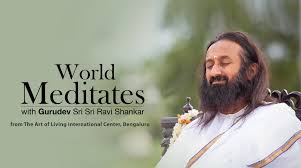
After many years, in 2001 to be precise, I did an entry level course with the Art of Living. Then it was called the Art of Living basic course. Now the entry level course for adults is Art of Living Course Part-1. I found it so amazing, I did the advanced and other specialised courses. I cannot compare Art of Living programs with programs offered by other spiritual organisations since I have not tried any other. But I can share my own experience with the Art of Living programs designed by Sri Sri Ravi Shankar. Each program has given me a unique experience.
Pujya Gurudev Sri Sri Ravi Shankar has the knack of explaining the most complex concepts in simple understandable ways. Art of Living also provides lots of opportunities for community service. The underlying motto is spirituality with social responsibility. For me, it has been a great inward journey.
 PEBBLES AND WAVES