
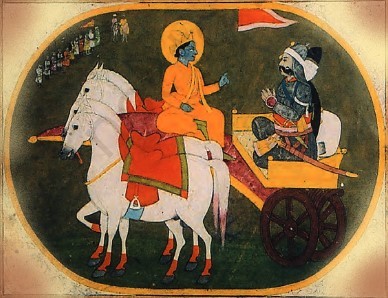
अर्जुन उवाच:
स्थितप्रज्ञस्य का भाषा समाधिस्थस्य केशव।
स्थितधीः किं प्रभाषेत किमासीत व्रजेत किम्।।
Arjuna asked: O Keshava !
How would you define a sthitaprajna who is established in samadhi? How does he talk? How does he sit? How does he walk?
The ancient text on yoga which is most talked about is The Yoga-sutras of Maharshi Patanjali. It is also known as Patanjali Yoga Darshana. The English word that comes nearest in meaning to Darshana is Philosophy. Patanjali Yoga-sutras is not a manual on various body postures. It is a treatise on enquiry into the inner world of human beings.
Patanjali Yoga-sutras has four sections. The very first section is called as Samadhi pada. According to the Yoga-sutras, the ultimate aim of a yogi is to attain the state of Samadhi. Our ancient Rishis first gave the goal and then the methods to achieve it.
Samadhi means – to be strongly established in a state of equanimity. Everyone experiences states of equanimity or deep inner peace for some fleeting moments. As one progresses in the path of yoga such moments increase. A stage comes when one is in a state of equanimity 24×7.
Maharshi Patanjali divides Samadhi broadly into two steps: Samprajnata and Asamprajnata. In Samprajnata samadhi one is in a very high state of awareness. But there is no cessation of mind and its modes. However, one is not effected by its activities. One continues to engage in action with a very high sense of awareness. In Asamprajnata Samadhi there is cessation of the mind. But one does not become a fool. It is a state of pure awareness.
Of course words are not enough to capture the essence of these sates. That was the reason the purest form of yoga was taught (and it is still being taught) in Guru-Shishya parampara. Such things were rarely discussed as intellectual pursuits or debated in public.
In Bhagavad Gita Lord Krishna starts his advice which are contained from the second chapter onwards. In this chapter which is titles as Jnana Yoga, Lord Krishna talks about a person who is established in Samadhi. He calls this person a sthitaprajna. The descriptions of a sthitaprajna comprise of stanza 56 to stanza 72 which is the last stanza of the chapter. I have tried to make a lyrical translation of those Sanskrit stanzas. These are part of my ongoing project on Bhagavad Gita. Here are the lyrical translation of some the stanzas :
In whom all desires of the mind
are cast off, O Partha
and whose ‘self’ is satisfied with ‘itself’ alone,
is said to be a sthitaprajna.

He, who does not feel let down in times of adversity,
nor gets elated in good times,
has transcended obsession, fear and anger
sages say such a person is a sthitaprajna.

He, who is without predilection for anything,
does not rejoice when outcomes are favorable
does not feel dejected when outcomes are unfavorable,
has his prajna established.

He who withdraws his senses
from sense objects like a tortoise
that withdraws its limbs from all sides,
 then his prajna is established

He who having subdued his senses
sits and gets connected to my divine essence,
his senses having been brought under control
his prajna is established.

While moving among sense objects,
having control over the senses
rid of obsessions and repulsions,
such a soul attains to grace.

Abandoning all desires the wise person
moves about without any obsession.
Without ego and without a sense of possession
he attains to the state of peacefulness.

This is the Brahmi-state, O Partha
No one who attains to this is deluded.
Getting into this even at the end of one’s life
one becomes liberated and merges with the Brahman.
Hope the reader has got some idea about a sthitaprajna who is established in Samadhi. A detailed discussion is beyond the purview of this post. One who is interested to delve deep into such concepts may do so with the help of a knowledgeable spiritual, or yoga master who is preferably himself a sthitaprajna.
A key takeaway of this post could be: It is important that we keep the goal in mind while undertaking any journey – whether outer or inner. If we lose sight of the goal we would not even know that we have deviated from the path. What is yours? Please let me know through the comment section of this post.
This post is a part of Blogchatter A2Z Challenge 2026
This year my theme is – Yoga A2Z
 PEBBLES AND WAVES
One thought on “Begin with the end in view”