
Students of modern medical sciences study human body as comprising of various gross elements like bone, flesh, blood etc. Even the mind has corresponding gross particles.
Ayurveda goes a little subtler. It recognises body as being consisting of gross as well as subtle elements like batta, pitta and kapha. Any ailment is regarded as the consequence of these subtle elements going out of balance. Batta , pitta and kapha are in turn connected with the five basic elements of the universe – earth, water, fire, air and ether.
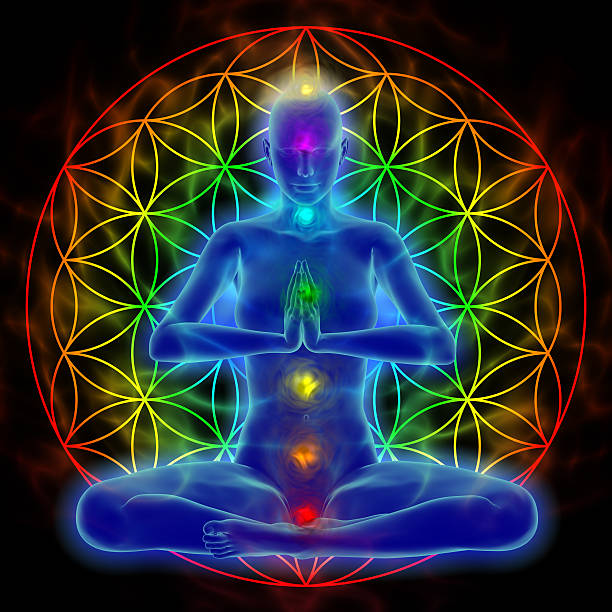
Yoga considers that the body is all about production and movement of energy. It has various points and centres of energy and there are dedicated energy channels. The body is surrounded by layers of energy fields. Our activities and mental attitudes effect those energy centres, points and layers.
The body has special energy centres called as chakras. The location and the names of the chakras are as follows:
| Sl No | Name of the chakra | Location | Association |
| 1 | Muladhara chakra | Base of the spine (near anus) | Survival instinct |
| 2 | Swadhisthana chakra | Genital region | Creativity |
| 3 | Manipur chakra | Naval region | Gut feeling |
| 4 | Anahata chakra | Centre of chest | Love |
| 5 | Visuddha chakra | Centre of throat | Self expression |
| 6 | Ajna chakra | Centre of eyebrows | Intuition |
| 7 | Sahasrara chakra | Top of the head | Heightened consciousness |
The body has many channels called Nadis for transporting gross and subtle elements and connecting various energy sources and centres. Thousands of such nadis have been described in ancient Indian Texts. However, three of these nadis are considered important. They are – Ida, Pingala and Sushumna. Ida is associated with the moon and the left nostril. Pingala is associated with the sun and the right nostril. Sushumna is the central channel along the spine.
According to vedanta, human beings exist at three levels – Sthula (gross), Shukshma (subtle), and Karana (causal). With death, the sthula sharira ceases to exist, but not the shukshma sharira the and karana sharira. Shukshma sharira is repository of our karmic impressions while karana sharira contains the seed of the being.
Another vedantic concept is that there are five layers of existence. The Taittiriya Upanishad classifies these as five koshas or sheaths. These are:
- Annamaya Kosha – Anna means food. This kosha referes to the gross physical body nourished by food.
- Pranamaya Kosha : This is the force or power that keeps things alive and active. It is related with breath because something that does not breath does not have life. Movement of any tangible or intangible material inside the body is caused due to winds known as prana vayus. These are five in number : Prana (helps in intake), apana (helps in expulsion of toxic material), Samana (helps in assimilation), Udana (helps in growth, expansion), Vyana (helps in circulation).
- Manomaya Kosha – It is the realm of your mind. It is said that mind travels faster than light. It can travel to places where it is impossible for the physical body to reach. In your mind you can create the world of your own. Manomaya kosha also includes your emotions and feelings.
- Vijnanamaya Kosha : It is when your intellect is engaged in impersonal contemplation about the nature of things or into existential issues. Intuition is part of Vijnanamaya kosha.
- Anandamaya kosha : It is the innermost kosha akin to the karana sharira. Annamaya kosha is regarded as equivalent to sthula sharira, while the next three koshas are said to be part of shukhma sharira.
One thing worth noting here is that the faculty engaged in day dreaming is not the same as the faculty engaged in intellectual contemplation. Faculty engaged in remembering things past and fantasising is connected with emotions where as the faculty engaged in intellectual contemplation is not associated with any emotion. That is the difference between Manomaya kosha and Vijnanamaya kosha.
The purpose of giving some background about chakras, nadis and sheaths is that many yogic and spiritual traditions have devised methods based in these concepts. Yoga literally means to connect. Yogic methods establish harmonious connections among various chakras, channels and sheaths so as to attain the ultimate aim of moksha or at a mundane level to have a healthy body and a sound mind.
Many types of spiritual practices and healing systems have been developed around these concepts. We will discover some of these in later chapters.
Yoga Trivia : The word yoga and nadi frequently occur in Indian astrological systems, though in different contexts. Various chakras have also been associated with specific planets and nakshatras.
This post is a part of Blogchatter A2Z Challenge 2026
This year my theme is – Yoga A2Z
 PEBBLES AND WAVES
This theme is very interesting. I was aware of the elements of Ayurveda, but did not know that segregation was related to human anatomy.
LikeLike