
Nada : Sound, Tone, Vibration, Resonant sound.
Nritya :  While Nritta represents pure, technical dance, Nritya is the interpretative, expressive dance that conveys Rasa (flavor/emotion) and Bhava (mood).
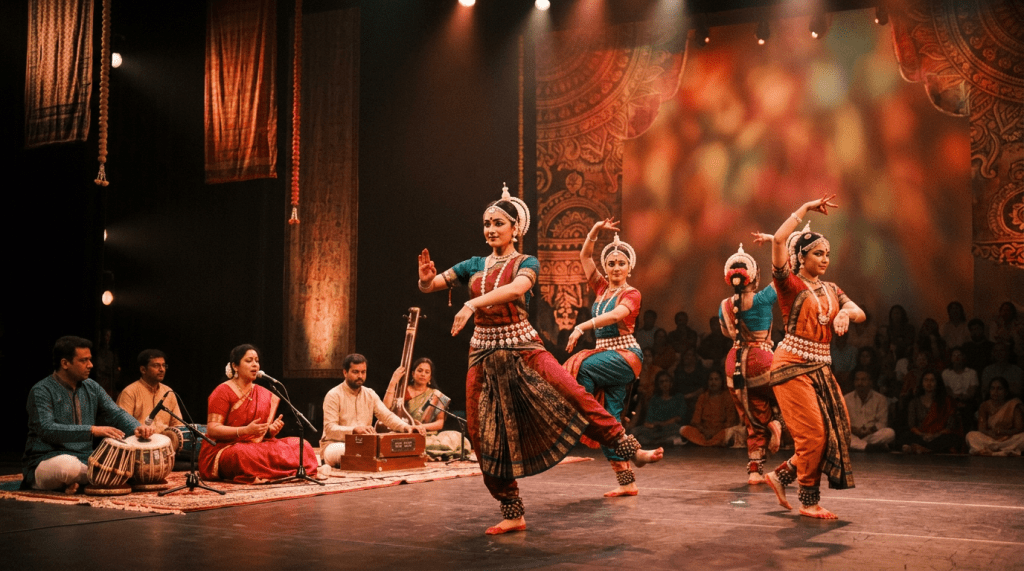
Can one’s music training itself be a kind of yoga? Can one’s dance training itself be a kind of yoga?
Yes. In fact Indian classical music and dance are deeply associated with spirituality.
In India, since time immemorial there have been two prominent forms of dance and music: classic and folk. While classical music and dance got centred and developed around spirituality, folk music and dance developed around both spiritual and non-spiritual themes.
In India we have two recognised styles of classical music: Hindustani and Karnataki. It is said that the distinctions in Hindustani and Karnataki styles of classical music got more accentuated due to external invasion. In the north, the music incorporated certain Persian influences and was no longer restricted to temple performances. Singers performed in the courts of the Kings. Hence sometimes Hindustani music is referred to as Darbari Sangeet. Same way many dance forms evolved in North India and most of them shifted from temple performances to Darbar Performances.
In south India the classical music did not lose its spiritual connections. It evolved over the years. Pioneers like Purandara Dasa, Thyagaraja, Muthusamy Dikshitar, Shyama Shastri and others composed thousands of songs that could be sung in Karnataki style. No doubt they themselves were great yogis and were deeply rooted in spirituality. They composed songs not only in Sanskrit, but also in other South Indian Languages.
Parallelly, classical dance forms like Bharat Natyam continue their primary association with spirituality. In the state of Odisha, both the Odissi style of music and the dance have long associations with temples. At present even though Odissi dance has got government recognition as a classical dance form, Odissi music has not been so lucky so far.
Did all forms of Hindustani music cease to of exclusive spiritual domain?
Even though due to external influences, Hindustani music was no longer the exclusive domain of temples, not all forms of Hindustani music lost their exclusive connection with spirituality. One of them is the Dhrupad style.
Dhrupad is said to be the most ancient form of Indian classical music. Its practitioners claim its direct connection with the Vedas and many Dhrupad artists also call themselves as Nada Yogis. Later on, many Dhrupad artists converted to Islam. But they did not delink Dhrupad from its association with Indian spirituality. Ironically the development of Dhrupad style is credited to Tansen, who himself converted to Islam and became a darbari singer of Akbar.
Sound is produced because of friction. Sound that is pleasant and rhythmic is music. There is a state where one can listen to that music which is produced without any friction. The Nada Yogi, by using sound, aspires to reach that state where sound is produced without friction. In yogic language it is called the anahata nada. It is not different from the state of Samadhi as enunciated by Patanjali in his Yogasustras. There are specific practices in Dhrupad style that focuses on carious chakras and gives the practitioner a transcendental experience. The ardent and skilful listeners of such music too can have the depth of meditation. Many of the Hindustani ragas are set in such a way as to give a meditative experience to the listeners.
Same way, dance can be defined as the rhythmic movement of the body. Many yoga postures and yogic mudras (hand gestures) are part of Indian classical dance postures. The dancer in the Indian classical sense aspires to reach a state where the dance and the dancer become one. That state is also akin to the state of ultimate Samadhi of a yogi. A skilful dancer can evoke a deep meditative state or bhakti in the discerning and empathetic audience. It can be a cathartic experience for both the performer and the audience.
The path of the Sufis is a kind of Bhakti marga. The Sufi dervishes have specific dance rituals that take them towards deeper inner journey. Sufi masters pass this on to their disciples.
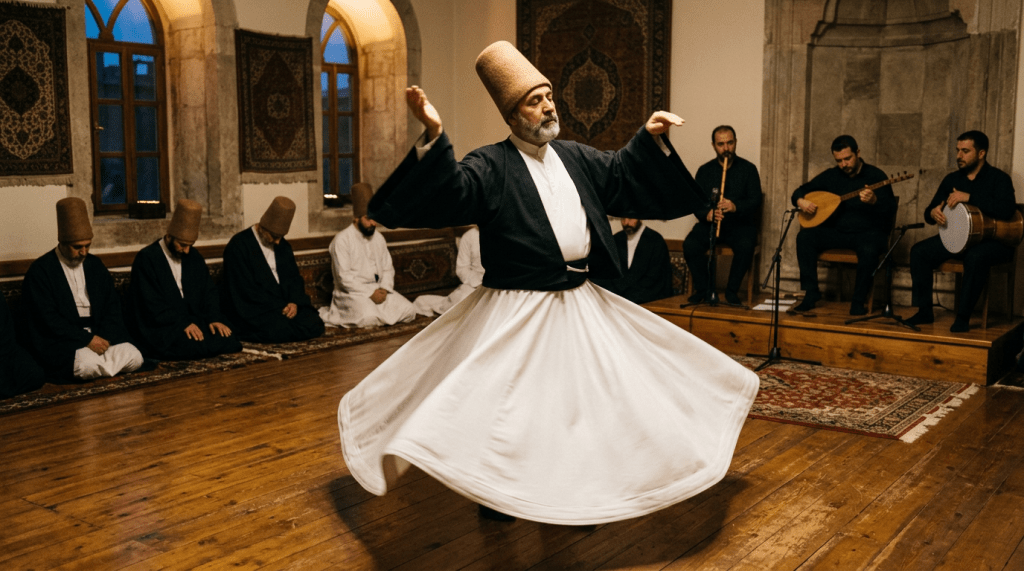
Nada is not all about singing. Non vocal sounds have also been used to effect various chakras of the body. In ancient times some of the temples had seven layers with each layer having a door. At each of the doors specific musical instruments were used to activate chakras beginning from the Muladhara Chakra. The ancient seers had found out which musical instrument activates which chakra. Here is a table showing various chakras and the associated musical instruments:
| Sl No | Chakra | Location of the chakra | Associated musical instruments |
| 1 | Muladhara | Base of the spine | Percussion instruments. Wind instruments like Shehnai |
| 2 | Swadhisthana | Behind genitals | Wind instruments like Trumpets, Pipes, and Saxophones, |
| 3 | Manipura | Stomach | Metallic sounds like cymbals (Manjeera) |
| 4 | Anahata | Heart | String instruments like Veena, Sitar, Harp. |
| 5 | Vishudha | Throat | Wind instruments like Flute. Piano |
| 6 | Ajna | In between eyebrows | Bells, Jal tarang |
| 7 | Sahasrara | Top of the head | All instruments put together or absolute silence |
Without being trained, is it possible to sing and dance one’s way to Samadhi?
Yes. Singing and dancing are prominent elements of Bhakti Yoga. In fact some are of the opinion that for the present era which is known as Kaliyuga, Bhakti is the best way to divinity. And Bhakti does not want you to be a trained singer or dancer. Here you are not performing for an audience. You are performing for yourself. In fact it is not even a performance. To let go can be part of your spiritual practices (sadhana).
This post is a part of Blogchatter A2Z Challenge 2026
This year my theme is – Yoga A2Z
 PEBBLES AND WAVES