
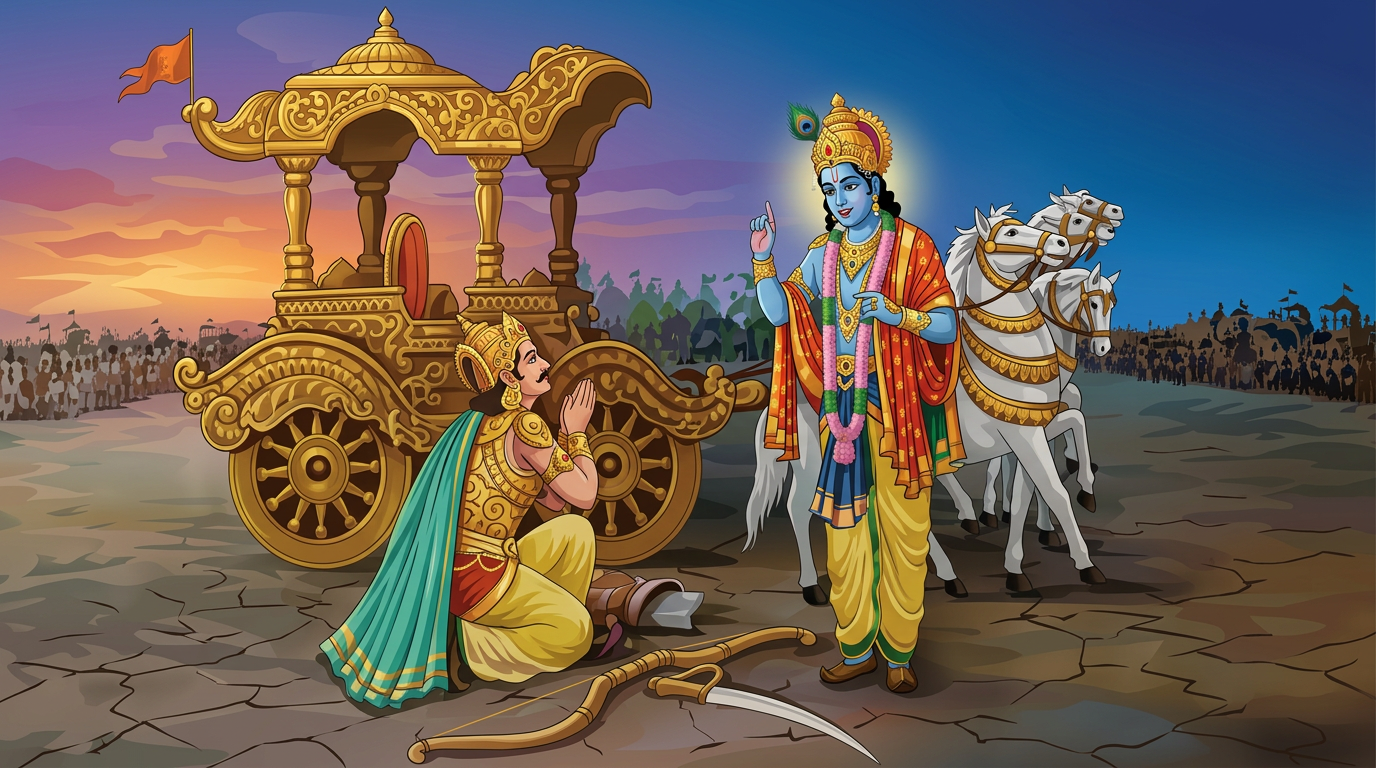
In our very first post in this series we have examined how Arjuna’s dilemma as to whether to fight against his own relatives or not became an existential issue. He was so confused, he began questioning his own integrity. He was doubtful about the direction of his belief system. He was not sure whether the way he lived was of any use to himself, to his family, or to the society.
Such desperation in the mind had its external manifestations. He confessed:
अर्जुन उवाच |
दृष्ट्वेमं स्वजनं कृष्ण युयुत्सुं समुपस्थितम्
सीदन्ति मम गात्राणि मुखं च परिशुष्यति |
वेपथुश्च शरीरे मे रोमहर्षश्च जायते ||
गाण्डीवं स्रंसते हस्तात्त्वक्चै व परिदह्यते |
न च शक्नोम्यवस्थातुं भ्रमतीव च मे मन: ||
निमित्तानि च पश्यामि विपरीतानि केशव |
न च श्रेयोऽनुपश्यामि हत्वा स्वजनमाहवे ||

Arjuna said:
O Krishna, seeing my own people
present here ready to fight,
my limbs fail me
and mouth is drying up.
There is shivering in my body
and my hair is getting raised.
I cannot hold on to Gandiva
and my skin feels like burning.
I feel restlessness
and my mind is reeling.
O Keshava, I see
omens inauspicious
and I don’t see any good
in killing my own people.

(The translation provided has been taken from my upcoming book : Hence O Arjuna Become a Yogi)
In the chapter on Human Body – the yogic anatomy I have discussed about gross and subtle bodies. In fact both are interlinked. Body and mind are interlinked. The emotions we feel have their manifestations in the body. High degree of desperation or stress threaten the physical existence. Since many of the problems have their origin in the subtle body, only addressing the physical body will not provide any solution. That is the reason taking medicines to correct physical ailments does not work in certain cases.
Yoga, as we have seen, takes an holistic approach to life. It aims to integrate all levels of existence. It works at all levels : physical, intellectual, and emotional. It aims to remove the cause of all phobias by making you develop the right attitudes to face the vagaries of life.
The central message of the Bhagavad Gita addresses the existential issues of life. Same goes for Patanjali Yoga Sutras and other texts based on Vedanta philosophy. Their purview goes much beyond providing temporary solutions to temporary crises.
There was a time when I was going through a rough patch. This rough patch had its toll on my body. I was lucky that the doctor whom I went to see recommended me yoga. He was not an Ayurveda or any ordinary doctor. He was a highly experienced and qualified doctor of modern medicine. That is how I restarted my yogic practices. During my teenage years I was an avid practitioner of yoga. I had discontinued it. Encouraged by the doctor, I got back to my practices.
This post is a part of Blogchatter A2Z Challenge 2026
This year my theme is – Yoga A2Z
 PEBBLES AND WAVES
Yoga makes us connect with ourselves at a deeper level. So it will definitely help us to address the existential issues we face. Nice insightful post.
LikeLiked by 1 person
Thanks for stopping by
LikeLike