
Many of the concepts of Eight Limbs of Yoga will be used extensively in this post. In case you are not familiar with those eight limbs please go through this blog post. Prior knowledge of eight limbs of yoga will help appreciate this post better.
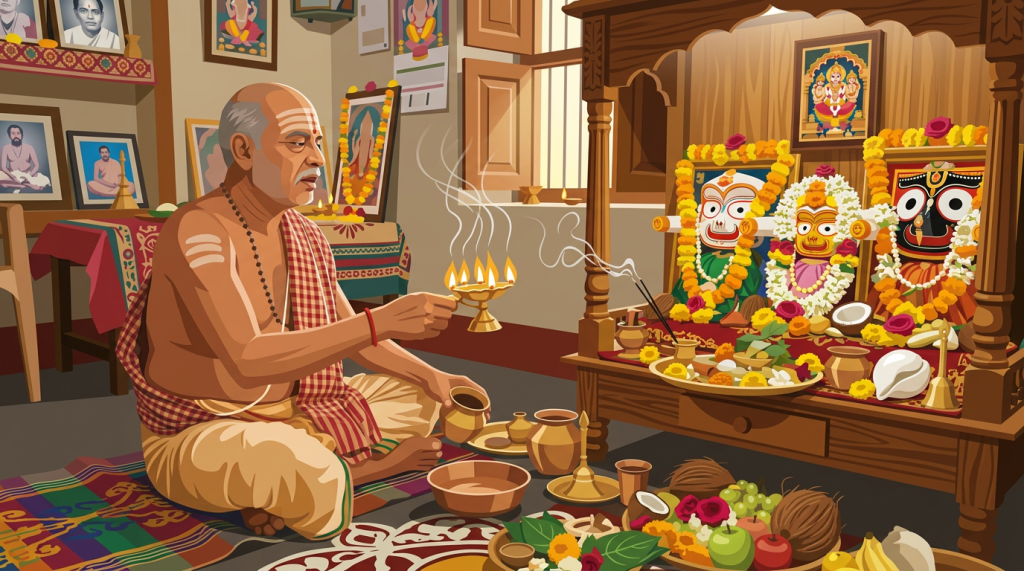
Puja is usually translated as worship or prayer. However, it connotes a set of rituals associated with a deity or a set of deities.
Puja is defined as Purnat jayate iti puja – that which is born out of fullness is puja. Sri Sri Ravi Shankar says that it is a way of expressing gratitude. Puja rituals consist of making certain offerings to the deity. These offerings are connected with the five basic elements – earth, water, fire, wind and ether. The gifts of nature are offered back to the divinity in a symbolic gesture of gratitude.
If performed as per the prescribed ritual, it will have similar effect as that of a set of hatha yoga practices. Some of the hath yoga practices are part of puja rituals.
That which is borne out of fullness is Puja. In a state of fullness one is contended. Contentment (Santosha) is part of one of the eight limbs of Yoga known as Niyama. Niyama is the second limb of Yoga. Niyama consists of five types of practices:
शौचसंतोषतपःस्वाध्यायेश्वरप्रणिधानानि नियमाः
śauca saṅtoṣa tapaḥ svādhyāya īśvarapraṇidhānāni niyamāḥ
Saucha means cleanliness. In Puja rituals lots of importance is given to cleanliness. It is taken care that the surroundings are clean. Taking a bathe is mandatory for everyone who participates in puja. In addition to taking bath with water (snana) there is this concept of purifying oneself with mantras (mantra-snana). Cleanliness and purification are part of the first stage of puja. Pranayama is also a part of Puja. Doing puja for long hours on empty stomach is a kind of tapas. On special puja days like Ganesha Chaturthi etc. there are food restrictions and many people fast. In puja of course there is Ishwara Pranidhana. So all elements of the second limb of yoga (Niyama) are parts of puja rituals.
Hatha yogis do various types of hand and finger gestures. These are known as mudras and mudras are part of puja rituals.
These days it is rare to see someone following all the steps of puja rituals meticulously. Puja should be done in a meditative and mindful way. However, what we come across is usually the pandits hurry up with the mantras. People who do puja also try to finish it off as quickly as possible. In stead of doing paranayama people chant the mantra meant for pranayama. If at all they do pranayama they do it hurriedly.
As far as I remember, my father used to do puja following all the procedures meticulously. He did all the rounds of pranayama and was meticulous with the mudras. Sometimes his near and dear ones used to get irritated because of the long hours he took for puja. But he would not compromise. Same way I also observe that Pujya Gurudev Sri Sri Ravi Shankar does puja in a meditative way. His meditation is so infectious that people around him usually also go into deep meditation.
If done properly, puja too can be a path to Samadhi.
This post is a part of Blogchatter A2Z Challenge 2026
This year my theme is – Yoga A2Z
 PEBBLES AND WAVES