

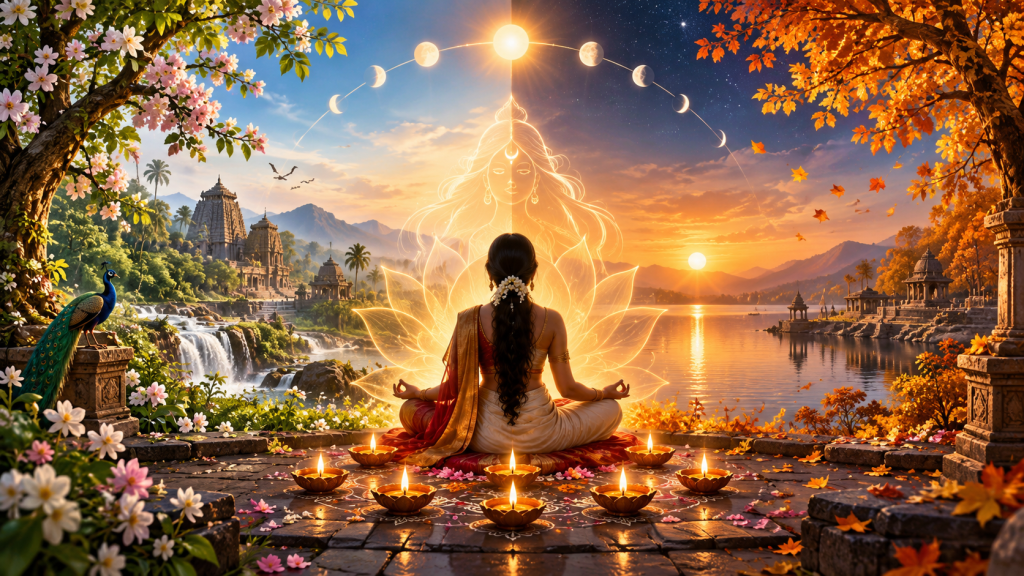
There is something deeply suggestive in the very word Navaratri. We commonly understand it as “nine nights” — nava meaning nine and ratri meaning night. Yet, almost playfully, the sound nava also evokes newness — nava, the new, the fresh, the renewed. This coincidence itself invites reflection.
Among the several Navaratri observances in the Indian tradition, two are especially prominent — Chaitra Navaratri in spring and Sharad Navaratri in autumn. Both occur close to the great seasonal transitions of the year, around the periods when the Sun crosses the celestial equator and day and night approach a state of balance.
The spring equinox announces the awakening of nature. Dormant life begins to stir. Trees sprout new leaves, flowers return, the air changes, and the earth appears to rediscover its vitality.
The autumnal transition is different, yet equally profound. Nature begins another kind of renewal — not always through blossoming, but often through shedding. Leaves fall. The old gives way. The excess is discarded. Life withdraws inward, preparing itself for another cycle.
Renewal does not always mean adding something new. Sometimes renewal begins by letting something old fall away. This makes the timing of Navaratri fascinating.
Did our ancient Rishis, through observation, contemplation and inner insight, perceive a relationship between these great rhythms of nature and corresponding rhythms within the human psyche? We may never be able to answer that question historically with certainty. Yet the possibility is worth contemplating.
The human being, after all, does not exist outside nature. The elements that constitute the earth constitute our bodies. The Sun governs the cycles of day and night that regulate our sleep and activity. The Moon influences calendars, tides and biological rhythms. Seasons affect our food, behaviour, energy and mood.
We may live today surrounded by concrete walls, electric lights, air-conditioning and digital screens, but our biology remains ancient. Somewhere beneath the noise of modern life, we continue to respond to the rhythms of the earth.
Our ancient seers designed traditions such as Navaratri to remind us of precisely this forgotten relationship.
For nine nights, the outward momentum of ordinary life is interrupted. There is fasting, prayer, discipline, chanting, worship, dance, silence or meditation, depending upon one’s tradition. Whatever the outward form, there is an invitation to turn inward.
And significantly, the Divine is worshipped during Navaratri as Shakti — the primordial energy behind creation, preservation and transformation. The symbolism is powerful. If nature can renew herself, why cannot we?
If a tree can release its old leaves without mourning them forever, why must we continue carrying old anger, old prejudices, old disappointments and old identities? If spring can bring forth new shoots from branches that appeared lifeless, perhaps something within us too can begin again.
The nine nights can therefore become nine opportunities for inner cleansing — to examine what we have accumulated, what we have outgrown, and what deserves to be renewed.
The celestial movements may appear distant, occurring millions of kilometres away. The changing seasons may seem merely environmental. Yet perhaps the ancient vision was that existence is not divided so neatly. The cosmos, nature and the human being belong to one interconnected rhythm.
Navaratri may therefore be more than a festival occurring on the calendar. It may be a reminder written into the calendar itself. Nature is renewing, the season is changing, and it is time for us to change too.
Wishing every one a happy Saradiya Navaratri.

