

Discover the rich traditions of Kartik month in Odisha, where spirituality and vibrant village life celebrate the divine and community.
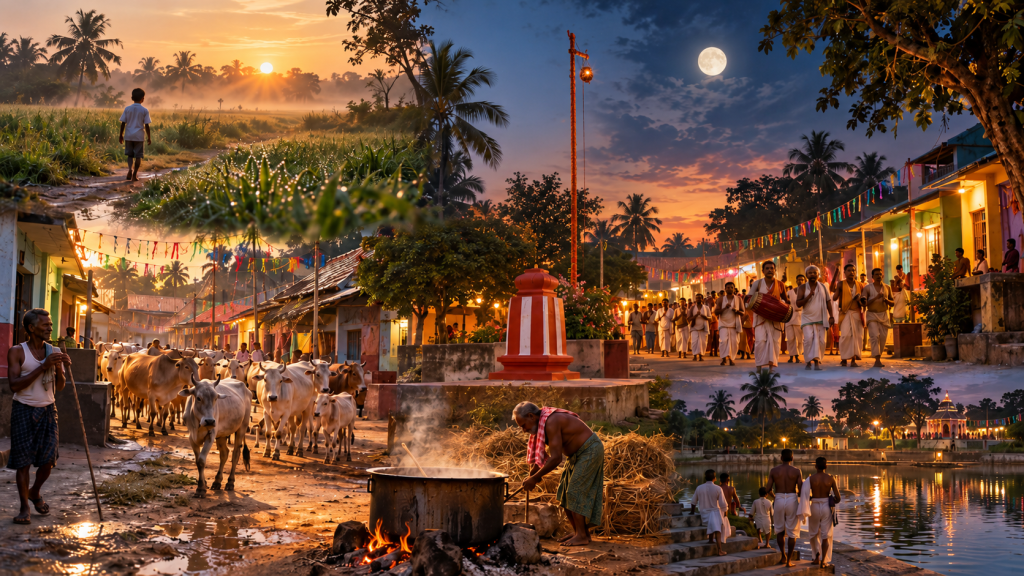
Today marks the beginning of Kartik, one of the most cherished months in the Odia calendar.
Odisha traditionally follows the Purnimanta system of reckoning lunar months, in which the month ends with the full moon. In many parts of India that follow the Amanta system, Kartik will begin about a fortnight later. Calendars may differ, but for an Odia, the arrival of Kartik carries a mood that is unmistakable.
After the colour and celebration of Aswin comes Kartik—the month when festivity seems to turn inward. The drums have not fallen silent, nor have the lamps disappeared, but something changes. Devotion becomes the dominant note. Temples seem busier, mornings more sacred, food simpler, and the chanting of the divine name becomes part of the rhythm of everyday life.
For me, Kartik is inseparable from memories of my village. If I remember correctly, the first dew of the season would begin to appear around the full moon of Aswin. Mornings suddenly felt different. Grass would be wet under the feet, mist would linger over the fields, and the air before sunrise would carry the first hint of winter.
Climate patterns may have changed. I now hear reports from some parts of Odisha that even at this time of the year it feels as though summer has not quite left. But in the Kartik of my childhood, the chill in the morning air was real.
And then came the Akash Deep. Near the central chabutara of the village, a long wooden pole would be erected. Every evening, almost like the raising of a flag, an earthen pot containing a glowing lamp would be hoisted to its top. The pot had small openings through which the light escaped in every direction.
It was a simple arrangement, but its effect was magical. These were days when streetlights in villages were either absent or unreliable. Against that deep village darkness, the Akash Deep seemed to anoint the sky—a star that had somehow descended and chosen to hang just above our homes.
Once the lamp was raised, another sound took over the night.
Hare Krishna, Hare Krishna,
Krishna Krishna, Hare Hare…
Hare Rama, Hare Rama,
Rama Rama, Hare Hare…
The village sankirtan group would begin its rounds. Singing, dancing and playing traditional instruments like Mridangam and cymbals, they moved from one part of the village to another. And this was not an occasional celebration. It happened every evening throughout Kartik.
The entire month acquired a certain discipline. Many people abstained from non-vegetarian food. Some followed stricter rituals. Others simply allowed themselves to be carried along by the devotional atmosphere.
Then, right in the middle of this deeply spiritual month, comes Diwali. How fascinating that Amavasya, the darkest night of the lunar cycle, should bring the greatest abundance of lamps! Diwali did not interrupt Kartik’s devotional mood; it seemed to add another dimension to it. Darkness became the canvas upon which light declared itself.
As the month moved towards its close came the sacred Panchaka, the final five days. People rose before sunrise and walked to the village pond or nearby river for a bath. By then the mornings were genuinely cold. I sometimes wonder how everyone managed to enter that chilly water so willingly. Perhaps faith has its own thermostat.
The spiritual crescendo arrived with Kartik Purnima.Fairs were organised around designated temples. Kirtan groups from neighbouring villages arrived and performed by turns. Around the sacred centre grew a temporary little marketplace—stalls selling clothes, savouries, toys and household articles. Faith, festivity and the ordinary needs of life sat comfortably beside one another.
But my village had one more Kartik memory particularly dear to me. On the eighth day came Goshtashtami—a day devoted to honouring the cows.
Most families then owned a cow or two, sometimes a few more. Professional cowherds would collect them from individual homes every morning, take the entire herd to open grazing grounds, and bring them back by evening. On Goshtashtami, they returned early.
Every cow was welcomed home ceremonially. A tilak was placed on its forehead, a garland around its neck, and specially prepared fodder offered with affection and gratitude. For a child watching it all, the distinction between ritual and daily life hardly existed. The animal that provided milk to the household and formed part of its everyday economy was, for one day, visibly acknowledged and honoured.
Perhaps that is what I remember most about Kartik—the sacred did not live somewhere far away. It lived in a lamp raised on a wooden pole, in dew on the grass, in bare feet walking towards a cold village pond, in the sound of Hare Krishna travelling through dark lanes, and in a garland placed around the neck of a cow returning from pasture.
I am happy that many of these Kartik traditions are still observed in my village. Time has changed the village. Electricity has conquered much of the darkness. Lifestyles have changed, occupations have changed, and perhaps even winter does not arrive quite when it once did.
Yet when Kartik comes calling, somewhere in my mind an Akash Deep is still being raised. And beneath its quiet light, my old village begins to sing again.

