
स तु दीर्घकालनैरन्तर्यसत्कारासेवितो दृढभूमिः ॥ १.१४॥
Sa tu dīrgha-kāla-nairantarya-satkārā-sevito dṛḍha-bhūmiḥ || Patanjali Yogasutras 1.14 ||
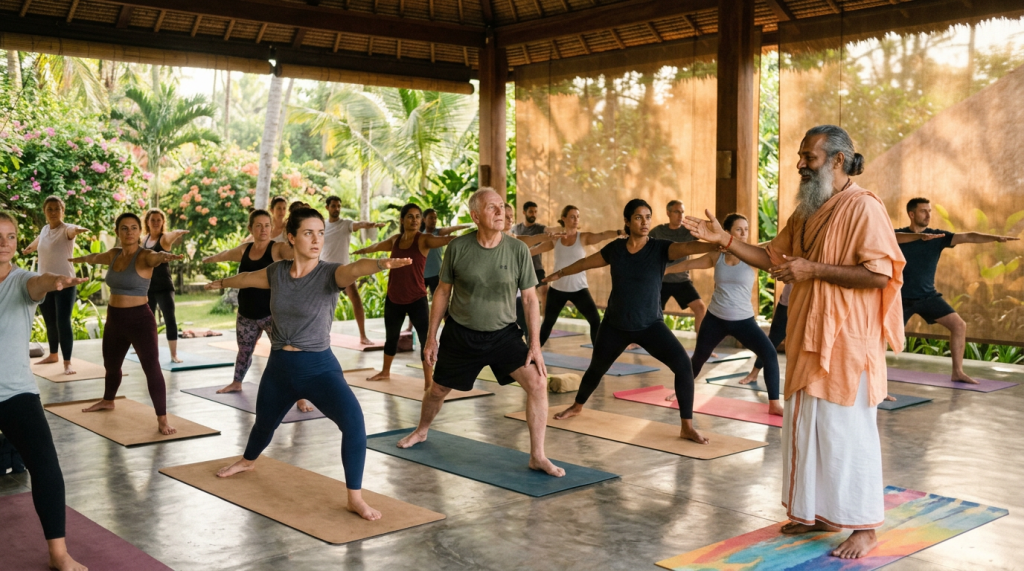
The sutra given at the top means: One’s foundation becomes strong if one practises regularly, for a long time, and with a sense of honour. Of course this requires some context. I must start from the beginning of the yoga sutras.
Patanjali defines yoga as having mastery over the modes of the mind and all the tendencies. Further, the Rishi says that this can be achieved by practice (abhyasha) and dispassion (vairagya). Only practice is not enough, It has to be accompanies by dispassion. In a way both are complementary. Practice of various techniques to control the mind will make dispassion easier. An attitude of dispassion or non attachment will bear quick results of the practices.
This particular sutra – sa tu dīrgha-kāla-nairantarya-satkārā-sevito dṛḍha-bhūmiḥ – is all about practice. It elaborates how one should practise.
The yogic routine recommended by a master or arrived at by the practitioner after deep research must be practised : (a) Regularly (b) For a long time (c) With a sense of honour. All three are important.
Many people take up yoga. They may even undergo a period of formal training. This is not only applicable for Hatha yoga, but also for other spiritual practices. But, most stop after a few days. Some stop immediately after they lose interest. Some carry on even though they are no more find the routine interesting. However, they stop after some time for lack of patience. . They may justify by saying that they tired but were going nowhere. Those who have the patience drag on and on. But they just do it mechanically. In this case also after some days they may complain that they are going nowhere.
There lies the catch. Samadhi is not an ordinary achievement. It is the achievement of all the achievements. To progress in the path towards Samadhi, only doing the practices is not enough. It must be accompanied by the sense of honour it deserves. It should be done with a sense of sacredness, even though it has to be done for years and years. Then the miracle happens. But the paradox is that if it is the miracle that motivates you, if the sense of achievement motivates you (because Samadhi is the achievement of all achievements) then also you are lost. Here comes the role of dispassion. One needs to maintain that delicate balance of dispassion and continuing practice with a sense of honour.
Does it mean that hose who are not doing it regularly, or not doing for a long time, or are not doing it with honour will not get any benefit out of their yogic practices?
No – says Lord Krishna. There is something for them also. He says:
नेहाभिक्रमनाशोऽस्ति प्रत्यवायो न विद्यते ।
स्वल्पमप्यस्य धर्मस्य त्रायते महतो भयात् ॥ ४० ॥

nehābhikrama-nāśo ’sti pratyavāyo na vidyate |
sv-alpam apy asya dharmasya trāyate mahato bhayāt  //Bhagavad Gita 2:40//

In this there is no loss
of efforts or side effects.
Even a very little practice
saves one from great fear.
So let this sutra of doing regularly, for a long time etc. not scare you out of yoga. In case you are interested just go and take the first step.
This post is a part of Blogchatter A2Z Challenge 2026
This year my theme is – Yoga A2Z
 PEBBLES AND WAVES
Some points to ponder. Whenever something becomes routine we lose interest for it.
LikeLiked by 1 person
Thank you so much for stopping by
LikeLike